Clean energy journalism for a cooler tomorrow

Trump emergency order casts uncertainty over grid battery growth

A sweeping yet vaguely worded national emergency declaration targeting Chinese grid tech could put gigawatts of grid battery projects on uncertain legal ground.
By Jeff St. John

  • Link copied to clipboard
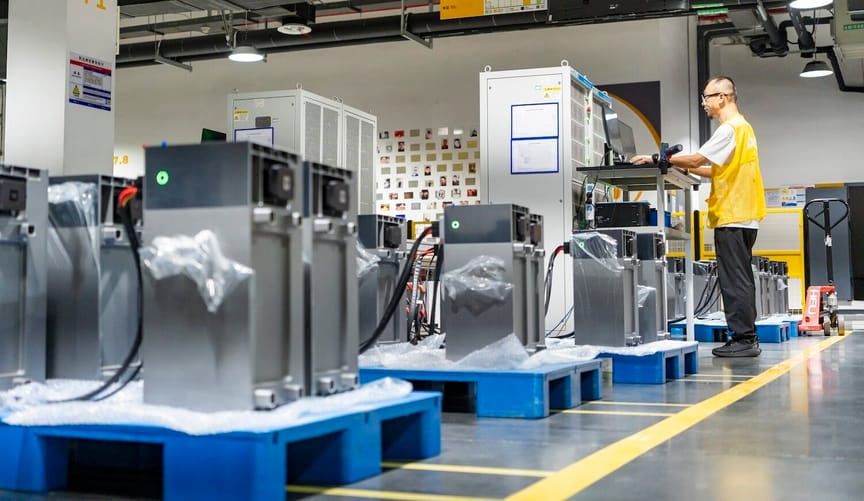
Factory scene with worker in yellow vest and silver battery products on blue platforms
A worker produces energy storage products for export at the AlphaESS workshop in Nantong, China. (Zhai Huiyong/VCG via Getty Images)

The Trump administration’s vaguely worded executive order on grid cybersecurity threatens to slow down the booming U.S. energy storage market.

The order, issued late last month, declares a national security emergency over the risk that foreign-made technologies could be used to hack into and disrupt the U.S. power grid. To combat this threat, the order bans the acquisition, importation, transfer, or installation of any foreign-produced bulk-power system electric equipment.”

These restrictions apply to any transactions initiated” on or after Aug. 26, when the order was issued. But they may also be retroactive: The order gives federal agencies the power to force utilities or energy project owners to identify, isolate, monitor, secure, disconnect, replace, or remove such equipment” that’s already been installed.

While the order isn’t aimed only at batteries — it includes a range of other grid equipment and the communications devices and control software that manages them — it’s the battery market that will potentially be the most affected.

While most of the 24 foreign entities” encompassed by the executive order aren’t major suppliers of grid equipment to the U.S., one of them — China — is, according to Keith Martin, an attorney and energy expert with law firm Norton Rose Fulbright.

The order does not clarify whether the ban applies strictly to the software and control systems that could expose Chinese batteries to remote tampering or control, or also to what Martin called the dumb” battery cells and modules as well. If the broader interpretation prevails, the consequences would be staggering: China makes roughly three-fifths of the lithium-ion batteries used in U.S. grid installations today.

The Department of Energy has 120 days — or until Christmas Eve — to issue rules and regulations that clarify the impact of the order.

So we have this period through Christmas where we’re facing this uncertainty,” said Martin, who noted this will make financing energy storage projects harder. The simplest remedy for energy storage developers would be that if you haven’t signed a contract to purchase Chinese equipment, don’t do it,” he said.

Batteries have been one of the rare clean energy sectors that hasn’t been attacked by the Trump administration. Indeed, battery deployments reached a new record in the second quarter of 2026, with 20.2 gigawatt-hours installed, equivalent to 10% of the country’s entire energy storage capacity, according to a report from the Solar Energy Industries Association and Benchmark Mineral Intelligence.

But since the order was issued, battery project developers have had to rethink their supply chains, said Ravi Manghani, senior director of strategic sourcing at Anza Renewables, a data analytics firm focused on solar and energy storage.

The industry can’t just stop while we’re waiting for information to come out of the DOE,” he said. But things have slowed down a bit, particularly on the energy storage side.”

In an Aug. 28 research note, analysis firm BloombergNEF agreed that battery projects face near-term delays or cancellations as developers await guidance, reconsider existing contracts, or shift suppliers.”

For now, it’s too early to tell the exact volume of projects that might face delays or cancellations,” Isshu Kikuma, BNEF energy storage analyst, told Canary Media in an email. That said, we see over 23 gigawatts of large-scale energy storage projects that have already reached financing close or are under construction. Some of these projects might face delays or cancellations in the worst case in the near term.”

These new complications are being layered atop the impact of unpredictable tariffs on Chinese batteries, as well as the more recently imposed foreign entity of concern” (FEOC) rules that ban Chinese batteries from earning lucrative federal tax credits.

Energy storage developers are increasingly seeking out non-Chinese battery suppliers to avoid these complications, Manghani said. But U.S. battery manufacturing capacity, while growing quickly, still can’t compete on price or volume with China, which supplies roughly 80% of the world’s lithium-ion battery cells.

Developers have other ways to hedge. They could, for example, buy dumb equipment and source the brains for the equipment in the U.S.,” or from countries and companies not targeted by the executive order, Martin said.

Separating the dumb” batteries from the smart” software and communications tech isn’t always easy, however. Some battery manufacturers make it difficult to swap out their own control systems with another company’s technology.

The executive order also targets inverters that connect solar, wind, and batteries to the grid, transformers and switchgear used in everything from substations to data centers, and any other critical component, software, firmware, digital service, maintenance service, or remote-access capability” that connects to the power system.

China plays a smaller role in these other technologies than it does in batteries, BNEF noted. For example, imported transformers and switchgear, which are currently in short supply given the booming demand for grid power, mostly come from manufacturers in countries that are not among the 24 singled out: Brazil, Canada, Germany, Mexico, and South Korea. But inverters produced in factories owned by Chinese companies in Southeast Asia and India still accounted for about 40% of U.S. inverter imports in 2025, according to BNEF.

U.S. buyers, under tariff and FEOC pressures, have been seeking out alternative sources of inverters as well, Manghani noted. That need became more pressing when the Trump administration issued a directive in July threatening to ban new inverters from all foreign countries, although the scope of those restrictions has yet to be clarified.

Back in 2020, during the first Trump administration, a similar ban on foreign-made bulk power system equipment caused panic in the market,” Martin said, because of its lack of clarity on what the order has made illegal. That order was revoked by the Biden administration in 2021, before it could take effect.

But the experience did give DOE officials an understanding of the kind of chaos such blanket restrictions could cause, he said — and how the federal government must balance legitimate cybersecurity risks with the risk of undermining U.S. grid reliability and electricity affordability.

The U.S. faces a pressing need for more electricity, if nothing else, to allow continued growth in data centers, which the president supports,” Martin said. And with timelines for new fossil-gas-fired power plant construction stretching into the early 2030s, there is no clear alternative to solar, wind, and storage” to add to the country’s electricity supply in the remainder of Trump’s term.

This signup form requires necessary cookies.

Allow marketing cookies to load the newsletter signup form.

Jeff St. John is chief reporter and policy specialist at Canary Media. He covers innovative grid technologies, rooftop solar and batteries, clean hydrogen, EV charging, and more.